IT Buyback: How Much Is Your Used IT Equipment Worth?
Walk into almost any server room, storage closet, or IT warehouse, and you’ll likely find shelves filled with retired laptops, servers, storage arrays, switches, and networking equipment — all of it a candidate for an IT buyback program most companies never think to use. Some have sat there for months. Others have gone untouched for years.
Ask why they’re still there, and the answers are usually the same:
- “We’ll deal with them later.”
- “They’re probably not worth anything.”
- “We’re not sure what to do with them.”
While those assets collect dust, something else happens — they lose value.
Technology depreciates quickly. Enterprise hardware that could generate thousands of dollars in recovered value today may be worth significantly less six months from now. At the same time, those idle assets keep occupying valuable storage space, add to inventory management challenges, and may still hold sensitive business data if no one has properly sanitized them.
Many organizations see retired equipment as obsolete. In reality, much of that hardware still has a place in the secondary market.
This is where an IT buyback program becomes an important part of IT asset disposition (ITAD). Instead of viewing retired technology as waste, businesses can recover value from eligible equipment while ensuring data security and responsible asset management.
The Problem: Throwing Away Value Instead of Recovering It
Technology refresh cycles are a normal part of doing business. Organizations upgrade servers to improve performance, replace networking equipment to support growing bandwidth demands, and refresh employee devices to maintain productivity and security. As new technology comes online, older equipment leaves production.
The problem isn’t replacing the hardware. The problem is assuming retired equipment has no remaining value.
Many enterprise assets still see strong demand in secondary markets. Businesses, data centers, educational institutions, managed service providers, and organizations with limited IT budgets often purchase quality refurbished equipment to extend existing infrastructure or reduce capital expenditures.
Unfortunately, many organizations never evaluate their retired assets before disposing of them. Instead, the equipment sits in long-term storage, goes straight to recycling, or gets written off as obsolete — even when it still holds measurable resale value.
Waiting too long creates another challenge. Like most technology, enterprise hardware depreciates over time. Every month equipment sits unused, its market demand and resale value can keep declining. What could have been recovered during a planned refresh may eventually qualify only for recycling.
Without a structured buyback strategy, businesses risk losing both financial value and the chance to reinvest those recovered funds into future technology initiatives.
Why IT Buyback Matters
Recovering value from retired IT equipment offers benefits that extend well beyond generating extra revenue.
Reduce the Total Cost of Technology Refreshes
Replacing enterprise infrastructure takes significant investment. Recovering value from retired servers, networking equipment, storage systems, and other eligible assets can help offset the cost of purchasing new technology. Instead of treating hardware replacement as a complete expense, organizations can lower the overall cost of future refresh projects.
Eliminate Unnecessary Storage Costs
Keeping retired equipment in storage isn’t free. Unused hardware occupies valuable warehouse or office space, requires inventory management, and often gets harder to track over time. By evaluating assets shortly after retirement, organizations can cut unnecessary storage costs while maximizing resale opportunities.
Improve Data Security
Retired equipment should never leave an organization’s control without proper data sanitization. Professional IT buyback programs build secure data destruction directly into the asset recovery process, so organizations can recover value without compromising sensitive business information. That lets businesses hit two goals at once — protecting confidential data while recovering financial value from eligible assets.
Support Sustainability Goals
Extending the usable life of enterprise technology cuts unnecessary electronic waste. When equipment gets refurbished and redeployed instead of immediately recycled, organizations support a more sustainable IT lifecycle and contribute to circular economy initiatives.
Buyback programs prioritize reuse whenever practical, which helps organizations reduce environmental impact while getting more use out of existing technology.
What Determines the Value of Used IT Equipment?
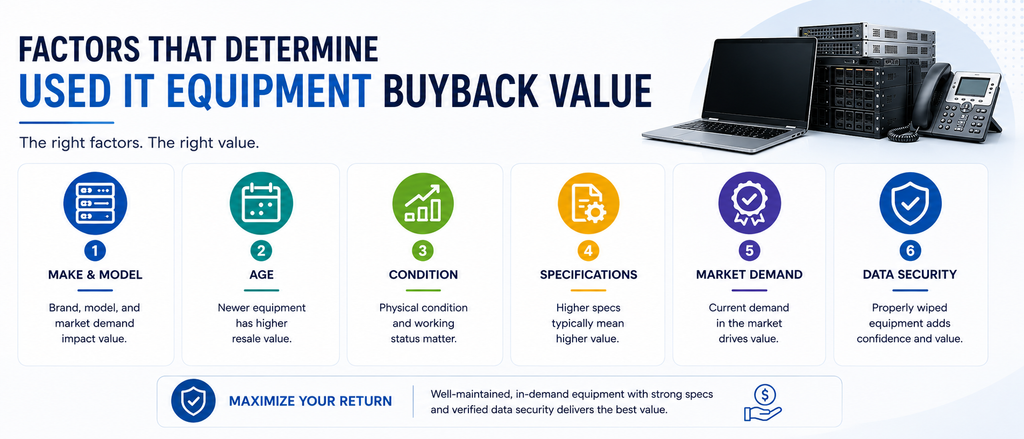
Not every retired device carries the same market value. Several factors influence how much an organization may recover through an IT buyback program.
Age of the equipment. Newer equipment generally commands higher resale prices because it offers longer remaining service life and stronger market demand. Hardware that recently reached end-of-life may still retain considerable value, especially if replacement cycles happen ahead of complete depreciation.
Overall condition. Well-maintained equipment typically performs better during evaluation. Physical damage, missing components, excessive wear, or incomplete systems can lower resale value, while clean, functional equipment usually gets stronger offers.
Market demand. Supply and demand play a major role too. Some enterprise servers, storage systems, and networking platforms stay highly desirable long after newer models arrive, since organizations keep expanding or maintaining existing infrastructure. Current market conditions often decide which products retain the highest resale value.
Manufacturer and model. Enterprise hardware from recognized manufacturers frequently holds stronger demand in secondary markets. Servers, networking equipment, storage systems, and other infrastructure from established enterprise vendors often command higher resale values thanks to their reliability, support ecosystem, and continued use across business environments.
Complete documentation. Organizations that maintain accurate asset inventories, serial numbers, configuration details, and maintenance records often simplify the evaluation process. Well-documented equipment lets buyers assess assets more efficiently, which streamlines the overall buyback transaction.
How an IT Buyback Program Works
A successful IT buyback program is more than simply selling used equipment. It follows a structured process that helps organizations recover value while maintaining security, transparency, and accountability throughout the asset’s retirement.
The specifics vary by provider, but the process generally includes these steps:
1. Asset Assessment
The process begins with an evaluation of the retired equipment. Organizations provide an inventory of the assets they want to retire, including details like manufacturer, model, specifications, age, and condition. This information lets specialists determine which assets qualify for resale and estimate their potential market value.
A comprehensive assessment also helps identify equipment that may work better for refurbishment, recycling, or certified data destruction.
2. Secure Data Protection
Before any asset enters the resale market, protecting sensitive information stays the top priority. Data-bearing devices should go through approved sanitization procedures that follow recognized industry standards. Depending on the equipment and organizational requirements, this may involve certified data erasure or physical destruction.
Only after removing sensitive information securely should eligible equipment move forward in the buyback process. This ensures organizations recover value without introducing unnecessary cybersecurity or compliance risks.
3. Equipment Evaluation
After data sanitization, specialists inspect each asset to determine its condition and resale potential. They evaluate factors such as functionality, cosmetic condition, hardware specifications, and current market demand. Equipment that meets resale criteria gets assigned a fair market value, while assets with limited or no resale potential head toward responsible recycling.
This evaluation gives organizations a transparent understanding of how value gets determined.
4. Value Recovery
Once the evaluation wraps up, organizations receive compensation for qualifying equipment. Recovered funds can help offset future technology investments, reduce refresh costs, or support other IT initiatives. Instead of letting retired assets depreciate in storage, organizations immediately convert unused equipment into measurable business value.
5. Responsible Asset Disposition
Not every device can or should be resold. Equipment that no longer holds market value should still go through certified recycling programs that recover reusable materials while minimizing environmental impact.
This ensures every retired asset follows the most appropriate path — whether that’s resale, refurbishment, or recycling.
Common Mistakes That Reduce Buyback Value
Many organizations unintentionally lower the value of their retired equipment before it ever reaches the secondary market.
Waiting too long. Technology depreciates quickly. The longer equipment sits unused, the more its market value declines. Planning buyback evaluations shortly after a hardware refresh helps organizations maximize potential returns.
Storing equipment without inventory. Assets stored without proper documentation often become difficult to locate or evaluate. Missing serial numbers, incomplete records, or unknown equipment conditions can delay the buyback process and reduce overall efficiency. Maintaining accurate inventories makes valuations faster and more transparent.
Ignoring data security. Some organizations hesitate to join buyback programs because they worry about sensitive information remaining on retired equipment. In reality, secure data destruction should always be built into the buyback process. Protecting confidential information and recovering asset value should never be treated as separate objectives.
Assuming everything should be recycled. Recycling is an important part of responsible IT asset disposition, but it isn’t always the best first option. Many enterprise assets retain value long after they leave production. Evaluating equipment before recycling helps organizations determine whether resale or refurbishment offers a better financial outcome.
Expert Insight
The most successful organizations don’t wait until equipment becomes obsolete before planning its retirement. Instead, they build IT buyback into their overall asset lifecycle strategy. By evaluating equipment during scheduled refresh cycles, maintaining accurate inventories, and partnering with experienced ITAD providers, businesses can reduce storage costs, improve data security, and recover more value from their technology investments.
Every retired asset should get viewed through three important questions:
- Can it still support another business?
- Does it retain measurable market value?
- If not, can it be responsibly recycled?
Answering these questions helps organizations maximize return while supporting both operational efficiency and sustainability goals.
Frequently Asked Questions
Many enterprise assets — including servers, storage systems, networking equipment, switches, firewalls, laptops, desktops, and other business technology — may qualify for buyback depending on their condition and market demand.
Value typically depends on factors such as age, specifications, condition, manufacturer, market demand, and the equipment’s overall resale potential.
Yes. Professional IT buyback programs build secure data sanitization into the process before equipment enters the resale market, so sensitive information stays protected throughout asset disposition.
Timelines vary depending on the size of the project and the asset evaluation process, but a structured buyback program moves equipment efficiently from assessment to value recovery.
Turn Retired IT Equipment Into Recovered Budget
Your retired servers, storage systems, networking equipment, and other enterprise assets may be worth more than you think. Instead of letting valuable hardware sit in storage — or sending it straight to recycling — discover how an IT buyback program can help you recover value while maintaining security and compliance.
Request a free IT equipment buyback valuation from Silverback Communications and learn how much your retired technology could be worth.
Want to estimate your potential return first? Use our IT Equipment Value Estimator to better understand the factors that influence buyback pricing and start planning your next technology refresh with confidence.