Anyone Can Say They’re “Certified” — But What Does That Really Mean?
Imagine you’re searching for an IT asset disposition (ITAD) vendor to handle hundreds of retired laptops, servers, and storage devices containing years of sensitive company information. You visit several websites, and almost every company claims to offer “secure recycling,” “certified data destruction,” or “environmentally responsible disposal.” At first glance, they all sound the same. But when you start asking questions, the differences become clear. That’s why R2v3 certification plays such an important role when selecting a vendor.
Can they explain how your assets are tracked from pickup to final disposition? Can they prove where downstream materials go? Do they follow audited processes for protecting sensitive data? Are their environmental and operational practices independently verified?
These are the questions that separate marketing claims from measurable accountability. In the ITAD industry, trust isn’t built on promises — it’s built on documented standards.
R2v3 certification is one of the most recognized certifications in responsible electronics recycling and IT asset disposition. More than just a badge on a website, it establishes a framework for secure data handling, responsible environmental practices, and operational accountability throughout the IT asset disposition process.
Understanding what R2v3 certification means — and why it matters — can help organizations make more informed decisions when retiring their technology assets.
The Problem: Taking “Certified” at Face Value
When evaluating ITAD providers, many organizations assume that a company advertising itself as certified automatically follows industry best practices. Unfortunately, that’s not always the case.
Marketing uses the word “certified” broadly, but not every certification measures the same things, and not every claim gets backed by independent audits.
Without understanding what a certification actually covers, organizations may unknowingly partner with vendors whose processes don’t match their security, compliance, or sustainability requirements. This becomes especially important when handling retired devices that still contain confidential business information.
Organizations aren’t simply handing over old hardware — they’re entrusting another company with equipment that may hold customer records, financial information, employee data, intellectual property, and other sensitive assets.
Choosing the wrong partner can expose organizations to unnecessary risks such as:
- Inadequate data protection practices
- Poor downstream accountability
- Improper electronic waste handling
- Missing documentation
- Compliance concerns
- Reputational damage if assets are mishandled
For this reason, organizations should evaluate certifications with the same scrutiny they apply to other business-critical decisions.
Why Certifications Matter
A certification is more than a marketing credential. When a recognized standards organization issues it, that certification shows a company’s processes have been evaluated against established requirements and remain subject to ongoing oversight.
For organizations selecting an ITAD partner, certifications add confidence that the provider follows documented procedures rather than relying on informal practices. This matters especially in a few key areas.
Data Security
Retired IT equipment often contains sensitive information that needs protection until someone has securely sanitized it. Certified processes help establish accountability for how vendors handle data-bearing devices throughout the disposition process.
Environmental Responsibility
Electronic waste keeps growing worldwide, which makes responsible recycling increasingly important. Organizations should manage retired equipment in ways that minimize environmental impact while maximizing opportunities for reuse and responsible material recovery.
Operational Accountability
Every retired asset should stay traceable from collection through final disposition. Documented procedures, asset tracking, and process verification help organizations maintain visibility throughout the IT asset lifecycle and support audit readiness.
Rather than relying solely on vendor assurances, certifications provide an extra layer of confidence that an independent evaluator has verified operational practices.
What Is R2v3 Certification?
R2v3, short for Responsible Recycling Version 3, is an internationally recognized certification standard developed for organizations involved in electronics reuse, refurbishment, recycling, and IT asset disposition.
Its purpose is to promote responsible management of electronic equipment while protecting sensitive information, supporting environmental sustainability, and improving accountability throughout the recycling and disposition process.
Unlike certifications that focus on only one aspect of business operations, R2v3 certification addresses multiple areas essential to secure IT asset disposition, including:
- Secure handling of data-bearing devices
- Responsible reuse and refurbishment practices
- Environmental protection
- Downstream vendor accountability
- Worker health and safety
- Documentation and process controls
- Continuous operational improvement
Rather than treating electronics recycling as simply disposing of unwanted equipment, R2v3 emphasizes responsible lifecycle management from the moment assets enter the disposition process until their final outcome is fully documented.
What Does R2v3 Require?
The certification includes detailed operational requirements, but its core principles fall into a few key areas.
Secure data management. Organizations handling retired IT assets must implement processes that protect confidential information throughout the disposition process. This includes maintaining appropriate controls for data-bearing devices and keeping information secure before equipment is reused, remarketed, or recycled.
Responsible downstream management. An ITAD provider’s responsibility doesn’t end when equipment leaves its own facility. R2v3 emphasizes accountability throughout the downstream recycling chain, helping organizations understand where materials go and confirming they stay handled responsibly after processing.
Environmental stewardship. The certification promotes responsible management of electronic materials by encouraging reuse whenever practical and supporting environmentally sound recycling for equipment that’s reached the end of its useful life. This helps reduce unnecessary electronic waste while supporting a more sustainable technology lifecycle.
Documented operational processes. Consistency defines certified operations. R2v3 requires organizations to establish documented procedures that support accountability, traceability, and continuous improvement across their ITAD activities.
How R2v3 Certification Protects Your Organization
For organizations retiring IT assets, R2v3 certification offers more than operational consistency — it provides confidence that critical processes are managed according to recognized industry standards.
Better Protection for Sensitive Data
One of the greatest concerns during IT asset disposition is making sure confidential information doesn’t leave the organization with retired equipment.
R2v3 places a strong emphasis on secure handling of data-bearing devices throughout the disposition process. Combined with documented procedures and appropriate data sanitization methods, this helps organizations reduce the risk of unauthorized data exposure while maintaining greater accountability over retired assets.
Greater Transparency
Knowing where retired equipment goes after it leaves your facility is an important part of responsible IT asset management.
R2v3 encourages organizations to maintain documented processes and oversight throughout the disposition chain. This transparency helps businesses better understand how vendors process, reuse, refurbish, or responsibly recycle their assets. Instead of relying on assumptions, organizations get real visibility into the journey of their retired technology.
Support for Sustainability Goals
Many organizations have established environmental, social, and governance (ESG) initiatives that include responsible management of electronic waste.
R2v3 supports these efforts by encouraging practices that prioritize reuse whenever practical, before recycling becomes necessary. Extending the life of technology reduces unnecessary waste while promoting a more circular approach to IT asset management. For organizations seeking to strengthen sustainability initiatives, partnering with a certified provider can help align technology retirement with broader environmental objectives.
R2v3 vs. Other Certifications
Organizations evaluating ITAD providers will often encounter multiple certifications. Each serves an important purpose, but it helps to understand that they focus on different aspects of business operations. For example:
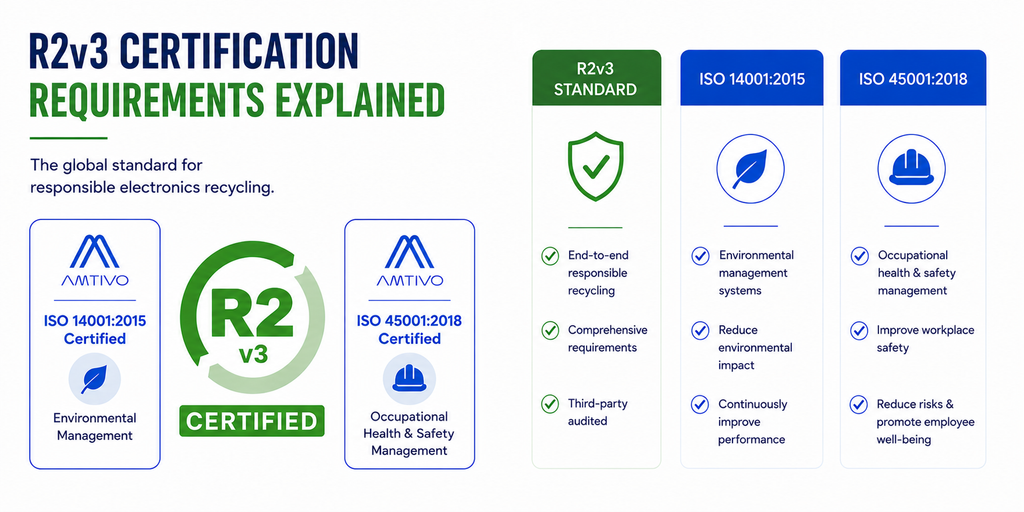
- R2v3 focuses specifically on responsible electronics reuse, recycling, IT asset disposition, and secure handling of data-bearing devices.
- ISO 14001 demonstrates an organization’s commitment to environmental management systems.
- ISO 45001 focuses on occupational health and workplace safety management.
Rather than replacing one another, these certifications often complement each other. An ITAD provider that maintains multiple certifications demonstrates a broader commitment to quality, environmental responsibility, operational consistency, and workplace safety.
When evaluating vendors, organizations should consider certifications as part of the overall picture, alongside documented processes, chain of custody procedures, data destruction capabilities, reporting, and customer support.
Common Mistakes When Evaluating ITAD Vendors
Selecting an ITAD partner involves more than comparing pricing or service offerings. Here are some common mistakes organizations should avoid.
Assuming every recycler meets the same standards. Not all electronics recyclers specialize in IT asset disposition. Organizations should verify that potential partners have documented processes designed specifically for handling enterprise IT assets and sensitive data.
Focusing only on cost. Choosing the lowest-cost provider may seem attractive, but it can introduce unnecessary risks if security, documentation, or operational controls fall short. The true value of an ITAD partner lies in protecting data, maintaining accountability, and reducing long-term business risk.
Ignoring documentation. A provider should be able to show how it manages every retired asset. Organizations should ask about asset tracking, reporting, chain of custody procedures, and documentation that supports audit readiness.
Not verifying certifications. Rather than relying solely on marketing materials, businesses should confirm that certifications are current and come from recognized certification bodies. Verification helps ensure vendors continue to meet the standards they advertise.
Expert Insight
Technology retirement is one of the few times organizations voluntarily transfer custody of equipment that may still contain sensitive information. That transfer requires trust — but trust should always come with evidence.
Recognized certifications such as R2v3 give organizations added confidence that their ITAD partner follows established operational practices designed to protect data, support environmental responsibility, and maintain accountability throughout the disposition process.
Combine R2v3 certification with a documented chain of custody, secure data destruction, and transparent reporting, and certifications become an important part of building a secure and responsible IT asset lifecycle.
Frequently Asked Questions
R2v3 stands for Responsible Recycling Version 3, an internationally recognized certification standard for electronics reuse, refurbishment, recycling, and IT asset disposition.
Yes. R2v3 certification includes requirements related to the secure handling of data-bearing devices as part of responsible IT asset disposition practices.
No. R2v3 focuses specifically on responsible electronics recycling and ITAD, while ISO certifications address broader management systems such as environmental management and occupational health and safety.
Businesses should request current certification documentation or verify certification status through the appropriate certification body before selecting an ITAD partner.
Partner With an ITAD Provider You Can Trust
When retiring technology assets, choosing the right partner is just as important as choosing the right process. R2v3 certification helps demonstrate a commitment to responsible IT asset disposition, secure data handling, and environmentally responsible recycling — but it should also come with transparent documentation, proven operational practices, and end-to-end accountability.
Talk to the team at Silverback Communications to learn how our certified IT asset disposition services can help protect your data, support your compliance goals, and maximize value throughout your technology lifecycle.
Want to evaluate your current ITAD provider? Download our Certified Vendor Verification Checklist to compare vendors with confidence and make more informed IT asset disposition decisions.